One of my students this term is from Africa. I was talking with her during a break one day, and I learned that she speaks at least four languages: French, her "mother tongue", the language of the town in which she grew up, and English. There may have been a fifth, but if so, I've forgotten.
She is not that out of the ordinary. Most of my students of the past year can speak at least two languages, not including English. If not languages, then at least two dialects of the same language. It seems the norm.
I wonder what this does to a person's perspective of the world. More than that, I wonder what it does to those culture's perspectives on the world and even their own communities. I wonder whether there has been research into whether or not there are measurable thought pattern trends in both multilingual individuals and multilingual societies. If there are measurable trends, I wonder what they might be.
Can anyone suggest any reading?
Friday, February 12, 2016

Sunday, January 31, 2016
Do you see segregation in this photo? I do.
 |
| Photo by woodleywonderworks, used under Creative Commons license. |
"The most segregated hour of the week is on Sunday morning."
Have you heard this? I have. I suppose the meaning is that people tend to go to church with people of their same backgrounds, be it a national background, a racial background, or what have you. Given that I go to a Chinese church with few non-Chinese, it's obviously not any empty sentiment.
Nevertheless, I don't think it's true. That is, it may be true in the racial or ethnic sense, but that's not the only kind of segregation. In fact, segregation happens anytime we force others to be separated from people who are different from themselves. When we think of the biases that exist, we think of sexism, racism, classism, and a few others. Too often, however, we ignore age.
In my opinion the most segregated time of the week is Monday through Friday, 8:30 to 3:00 (or thereabouts). We call it elementary school, middle school, and high school. We call it 1st grade, 2nd grade, etc. Here we force children, for many hours every day, to be with other children of approximately the same age, give or take a few months. We enforce this segregation as if kids have nothing to learn from those older than themselves or younger than themselves, as if they have no skills to develop by interacting with students who are older or younger than themselves. And this despite the fact that children have primarily interacted in mixed-age groups throughout history, pretty much up until this Prussian experiment we call the public school system.
We force upon our children an unnatural division as if all students of a given age are supposed to hit the same milestones at exactly the same time, as if they can't be inspired by those older than themselves, as if the can't learn empathy and compassion and capacity to nurture others by being with those younger than themselves. What's the most segregated place in America? The public schools. It always has been. Brown vs Board of Education of Topeka legally destroyed institutionally approved segregation of schools by race. I fear it's merely wishful thinking to image a similar ruling based on age.
There are many kinds of bias and discrimination. There are many ways that we, as humans, segregate ourselves. In almost every case, these discriminations and segregations bring about primarily negative results. It's time we rethink what we think we know about public education. It's time to reevaluate how we segregate children from one another. In a world where young people are increasingly only amongst peers, 24 hours a day (thank you, social media), it's time to rethink and recognize the value of students mixing with those of a variety of ages.
Saturday, January 23, 2016
Word of the Year: "They"!

If you hadn't noticed, the American Dialect Society released their annual Word of the Year on January 8th. This year's winner was the singular "they".
I'm excited about this. The singular pronoun "he" used to refer to a single person of any gender has been out of favor for a long time. It belongs to a more gender biased era. Since then, writers and speakers alike have had to employ the clunky "he or she" pronoun pair or try to do things like alternate masculine and feminine pronouns. Too much mental gymnastics. Oh the perils of a language without a non-gendered third person pronoun appropriate for humans! Enter singular "they".
Singular "they" has long been used in common speech to refer to a single person when gender is either unknown or unspecified. Prescriptivist grammarians, however, have long stuck up their noses at the use of singular "they" in any form, but especially in writing. I know I have often simply advised students to use plural subjects as often possible, thereby avoiding both the wrath of overly prescriptive readers or hearers and the awkward "he or she" constructions. Could that time be coming to and end?
Will the American Dialect Society making singular "they" the Word of the Year suddenly lead to a widespread shift in opinion about singular "they". Absolutely not. Language change (and acceptance thereof) doesn't happen that quickly. The prescriptivist tradition will continue to maintain the status quo for the foreseeable future and perhaps beyond. Nevertheless, I can at least hope that this might accelerate the shift so that we can all enjoy the wonders of singular "they" in all areas of life.
Monday, January 12, 2015
Flipped: A Teacher's Reflection
What did I think about my first attempt to flip a classroom? What were some positives and negatives? What might I need to adjust or change?
Some of what I liked:
Students, as whole whole, seemed much more engaged. Students would ask questions about what they viewed and about quizzes they took. The pace and structure of class time (sans lectures) forced students to be attentive; there was always something to DO, as idle or even passive moments were few and far between.
The class was incredibly active. Not having to spend time introducing grammar material in class, time could be spent doing activities: discussions and group tasks, cognitive and physical, at the board and even on the floor. This helped maintain students' focus and kept student from always just sitting in their desks for 50 minutes.
The class was incredibly interactive. Students' questions drove "teacher time". Students sought feedback throughout class activities. Yes, I transitioned from activity to activity, but so many of those transitions were based on the pace and needs of students. Lesson plans became lesson concepts or even lists of possible activities, all contingent on how students reacted to the activities in which the students where engaged. It was like one big feedback loop.
I could enter class with more confidence that I knew which aspects were causing students difficulty, which things they "weren't getting". I knew the content they were to have covered, and I could see which questions were proving troublesome to many students or which students were having trouble with which questions or tasks. Much more than ever before, I could enter the classroom with data-driven understandings rather than intuitions and perceptions.
Class time was maximized. At least this is my estimation. The time I most value is the time to work through the difficulties students have. Close behind is the time used to strengthen students' skills. By taking the lectures (which would have otherwise occupied time during class) and moving them online as homework, significantly more time became available to focus on those things that I, as a teacher, can really bring to the classroom.
What I didn't necessarily like:
Busy Busy Busy
Record keeping and observations were never-ending. Which students completed the quizzes? Which students watched the tutorials? Who is completing homework. You need to be aware of this every morning. (Thankfully, Moodle keeps statistics, which meant I could see the exact times that students watched tutorials, completed quizzes, or even clicked links to extra resources!)
Which quiz questions or topics are causing difficulty? If you don't know this, you won't know to address that in class. This meant that almost every morning required assessment of problems, record keeping, and adjustment to planned lessons, all before 8:30 a.m. It sometimes felt overwhelming, but it always felt worthwhile.
Also, as this past term was not a "flip" I had planned, I was doing all my work on the fly, usually only a day "(sometimes a few minutes) ahead of the students. The stress was palpable. Once done however, only tweaks are needed. I think I'm sitting relatively pretty for this next term.
Participation
There were three students who rarely (if ever) could be cajoled into participating in the flipped model. One student had excellent grammar skills already. That student only sporadically watched tutorials or took quizzes (ungraded) when he felt necessary. I wasn't worried about him. A second student was a bit more consistent, but his skills were lower and he could've used more practice. He still passed.
The third student simply would not do the work outside of class. Could he log on? Yes, he showed me. Did he log on? No. In spite of repeated encouragements and admonitions, in spite of emails and after class discussions, the student simply would not watch the tutorials. He never watched even one tutorial and completed but one quiz. It showed in his exam scores.
Had it been a traditional classroom style, would he have done homework? Perhaps not. Nevertheless, it is cause for pause when students refuse to "flip" with you.
Conclusion
Flipping a class is a lot of work. A LOT! (Unless, of course, you can rely on other people's Youtube videos. That would never do for me.) Nevertheless, I loved it. The students, by and large, loved it. I've spent this winter holiday tweaking quizzes, reorganizing materials, and reshooting some videos, all in the excitement of trying it again in just over a week!
Monday, December 22, 2014
Do students like it flipped?
If a teacher "flips" a course, obviously that teacher believes it is a useful thing to do. Rarely would a teacher go through the work to completely revamp a course without thinking it is to their students' benefit. But, what do students think?
Personally, I received an overwhelmingly positive response. Anecdotally, I had three students mention how much they liked being able to watch lectures at home, skipping ones they already knew, and reviewing areas of difficulty. Another students mentioned that he used the online lectures to review before tests, and the usage logs bear this out.
In addition, there were some great comments in the evaluations*. Some of those comments (the more instructive and exciting are listed below:
Of course, not every student connects well with a given method. Below is a criticism** of the method and, I suppose, me:
My reaction to this: I need to make the purpose of a flipped class even more explicit. Given that my class was questions-focused, given that I began every lesson by eliciting their questions, given that I assigned homework with the instruction that students were to write down any and all questions, I find it hard to believe that the student thinks I try to avoid questions and interactions.
That said, I know I can also make adjustments to make it clear that questions are not only welcome, but necessary to our class. I will need to be more explicit when explaining that the whole point of online lectures is to maximize time for questions and inquiries.
Onward we go!
* Evaluations are done anonymously and without course instructors present.
** Two administration aspects not related to flipped instruction were omitted.
Coming Soon: My own reactions
Personally, I received an overwhelmingly positive response. Anecdotally, I had three students mention how much they liked being able to watch lectures at home, skipping ones they already knew, and reviewing areas of difficulty. Another students mentioned that he used the online lectures to review before tests, and the usage logs bear this out.
In addition, there were some great comments in the evaluations*. Some of those comments (the more instructive and exciting are listed below:
- The Moodle videos that Matthew prepares for his students as a review are very helpful. Even if we miss a class we can understand them.
- This teacher is really good. He do a lot of activities to practice all the topics and to involve all the students during the class.
- I have had class of listening and speaking with Ms. Showman before in the last term, and I did not like so much, but I always notice your effort and interest in class. Now in Grammar and Writing I love his classes. Also it is important to say that his videos in moodle are SO helpful and great. I am learning grammar as never before. And he is so kind and patient with our questions. Your organization is amazing.
Of course, not every student connects well with a given method. Below is a criticism** of the method and, I suppose, me:
- The teacher explain most of his ideas using Moodle website by uploading videos. I think it is better to explain the lecture materials inside the class, an that help us understand and ask some questions that could help us. I think the teacher try to escape from the questions that students could ask during the lecture. There is no interesting because there is no questions, ideas, and interactions during the lecture, and that because most of lecture materials that we study are online.
My reaction to this: I need to make the purpose of a flipped class even more explicit. Given that my class was questions-focused, given that I began every lesson by eliciting their questions, given that I assigned homework with the instruction that students were to write down any and all questions, I find it hard to believe that the student thinks I try to avoid questions and interactions.
That said, I know I can also make adjustments to make it clear that questions are not only welcome, but necessary to our class. I will need to be more explicit when explaining that the whole point of online lectures is to maximize time for questions and inquiries.
Onward we go!
* Evaluations are done anonymously and without course instructors present.
** Two administration aspects not related to flipped instruction were omitted.
Coming Soon: My own reactions
Saturday, December 20, 2014
Flipping it
This past term I made a decision to "flip" my classroom.
I wasn't thinking about "flipping" when I did it. It was something I simply fell into.
A day or two before the term started, I was daydreaming about how my grammar lessons could be delivered more effectively. Between the cognitive psych research I read and my own experience of giving in-class introductions to grammar concepts, introductions that didn't seem all that useful anyway, I thought there must be a better way.
Suddenly it dawned on me that I had both Moodle and Blackboard at my disposal. I had Google Drive/Docs, which I was already using for in-class activities. I knew how to shoot videos from my laptop and Moto X, which I'd already been using to create materials for Listening/Speaking class. Everything I needed was quite literally at my fingertips.
What if I made short videos of the grammar lessons and hosted them on Drive? What if I posted all of these in Moodle or Blackboard? What if I wrote online quizzes to both (a) ensure students were interacting with the materials and (b) assess which points students were having difficulty with before ever entering the classroom? What if I focused in-class attention on those points? What if in-class grammar lesson time was focused completely on students' questions, practice, and quizzing? What if I never lectured at all?
It's not my personality to do something little-by-little. I'm not one to say "If I have time, then...".
No, if I'm going to do it, I'm going to do it.
This was a busy term. If I wasn't prepping materials or marking homework or grading assessments, I was writing and shooting videos and writing hundreds of quiz questions. In the end, however, I had a course that excited me, excited (most) students, and left me satisfied. Over this winter break, I will be reshooting some vids and I'll be revising some materials, but as a whole it was a great experience.
Coming Soon: Reactions, both my students' and my own.
Friday, June 06, 2014
Life: Unplugged
Why you should unplug, was posted on Edudemic exactly a month and a half ago. (The infographic can be seen below.) While I fault the article for not revealing the sample sizes or demographic data, the data is still sobering.
Some people see the data and recognize that at least some parts of it ring true in their own lives. Many other people (perhaps even the majority) see the data and think, "I'm not like that". The truth is that most of us are average. Despite what we think about our behaviors and responses, the vast majority of us are decidedly average. Which means that no matter what you or I think about our plugged in lives, we should generally assume that we fit the general trends, like average people do.
I personally have a contentious relationship with technology. Some of this is on display in past articles such as this, this, and this. On one hand, I love the convenience of the cloud and Evernote and online research and Moodle. On the other hand, I see how easily I can get distracted by the interactivity, I see how the fallacy of multitasking affects my work, I see how easy it is to be absorbed into things I don't need to be reading or viewing or listening to. Not bad things, mind you, but things that bring no benefit to my life or to the lives of others.
Computer technology is here to stay and will have a place in more and more arenas of life. How we use it is important. When we use it may be ever more important.
How plugged in are you? Are you due for an unplugging? Do you see yourself in any of the statistics?
Follow me on Twitter @MatthewTShowman
 |
Monday, June 02, 2014
College at its best?

A few weeks back I read this post by Anne Curzan, professor of English at the University of Michigan. In the post she wrote:
College at its best is about taking the time and the chance to find what you’re passionate about—from a major to a profession to a cause to a place in the world, and the list goes on. It’s about taking control of your experience and education (in the broadest sense) to make it what you want it to be—not what you think someone else thinks it should be.I've been thinking through these ideas ever since.
You see, some of the ideas resonate within me, but others hit a nerve or two. Some of the ideas do both. Unfortunately, I've been having difficulty putting words to my reactions.
Is this college at it's best?
I'm very pro vocational colleges. I'm very pro trade schools. I'm very against what too many colleges and universities have become: glorified trade schools where people go to train for jobs.
I'm very pro creativity. I'm very pro critical thinking. I'm very against the idea that merely expressing one's thoughts is the final goal in itself.
I'm very pro diversity. I very pro freedom of speech. I'm very against the mob rule that has become the modern concept of inclusiveness, which is neither diverse nor freeing.
So in that vein:
- Shouldn't college at its best involve training young minds to think?
- Shouldn't college at its best involve a pursuit of higher standards for self, for others, for the world?
- Shouldn't college at its best involve the developing the rigor needed to push into new frontiers?
- Shouldn't college at its best involve challenging ideas and having one's own ideas challenged?
- Shouldn't college at its best involve learning to disagree academically and with civility?
- Shouldn't college at its best involve listening to others who may be smarter or wiser than yourself?
- Shouldn't college at its best involved being humbled?
- Shouldn't college at its best involve more than just what you want it to be?
Nevertheless, college at its best is more than what I thought it should be when I was there, and I would guess that it should be more than what many of today's students think it should be as well.
Follow me on Twitter @MatthewTShowman
Friday, May 30, 2014
Teachers are (or should be) role models

I'm my own worst critic. OK, I don't know that that's true, but I know I'm constantly critiquing myself. I'm often genuinely surprised when people find what I do valuable or inspiring or helpful.
There are many reasons for my potentially overly self-critical disposition. Perhaps one of the strongest reasons is the sense of responsibility I have in the knowledge that, life it or not, I am a role model. Teachers are role models.
Teaching reveals this. Having children of one's own makes it even more clear. My actions and my words, planned or spontaneous, kind or cruel, set the tone for classes, weeks, even terms. The way I live is part of my teaching, whether my students or my children. It's more true than people realize that actions speak louder than words.
I'm aware that what I eat sends messages. I know that how and where I spend my "free time" sends messages. I realize that what I post on online is not innocuous. I'm aware that how I interact with others, in reality and in virtual reality, sends messages. I know that how I spend my money matters. I realize that what I indulge and do not indulge is not simply a "personal decision" without social effect.
I also know how severely I fail to meet my own expectations. I'm am probably more aware of my folly and failures than I am of my successes. With my children even more than my students. Sometimes it seems that every loss of temper and every poor example is indelibly engraved in my memory. That's obvious hyperbole, but it's more true than than saying I recall my successes.
I don't always cope with this pressure well. I'm too hard on myself, I always have been, which arguably leads to more errors in judgement. Nevertheless, I press on knowing that I set out to change lives, and change lives I will. I step forward in faith that students will somehow acquire what is important and will graciously ignore or forget my mistakes. We live not for ourselves.
Are many of you like this? Are you aware of the importance of the examples you set? How do you maintain perspective?
Follow me on Twitter @MatthewTShowman
Monday, May 26, 2014
Math skills vs. Reading skills [infographic]
Is reading more difficult than math? Could it be?
I've too often heard people complain that math is hard or that they hate math. I've always found it sad. Over the years, I've gotten the impression that I'm a rare breed: someone who loves both math and language, and I'm endorsed to teach both.
I hear people say that they don't like reading. Usually they mean books. But I rarely hear people say it in the way that people complain about math. Does that mean reading is easier? Does that mean people have a better grasp of reading than mathematics? Not necessarily.
Edudemic recently posted "Which is easier: math or reading?" It looks at the numbers and gives a convincing argument that students in the US are having much more difficulty learning to read than learning math. If accurate, this would be a huge problem, as the vast majority of the world's academic, technical, and otherwise useful information is in written form. Poor reading skills creates an almost impenetrable barrier to further learning.
Read the article, and peruse the infographic below.
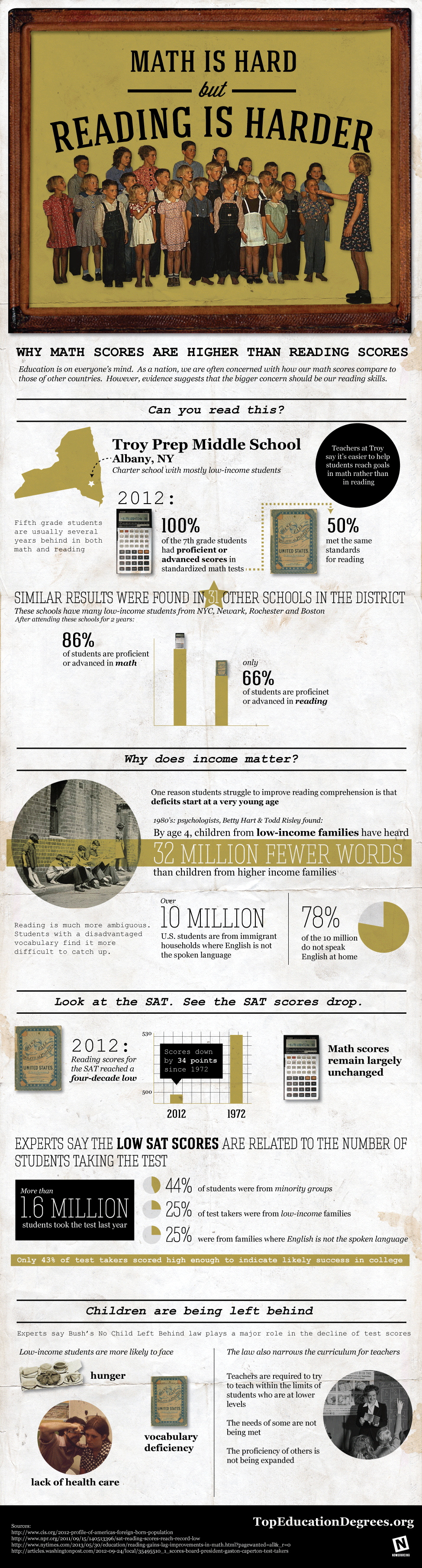
Image source: www.topeducationdegrees.org
Follow me on Twitter @MatthewTShowman
I've too often heard people complain that math is hard or that they hate math. I've always found it sad. Over the years, I've gotten the impression that I'm a rare breed: someone who loves both math and language, and I'm endorsed to teach both.
I hear people say that they don't like reading. Usually they mean books. But I rarely hear people say it in the way that people complain about math. Does that mean reading is easier? Does that mean people have a better grasp of reading than mathematics? Not necessarily.
Edudemic recently posted "Which is easier: math or reading?" It looks at the numbers and gives a convincing argument that students in the US are having much more difficulty learning to read than learning math. If accurate, this would be a huge problem, as the vast majority of the world's academic, technical, and otherwise useful information is in written form. Poor reading skills creates an almost impenetrable barrier to further learning.
Read the article, and peruse the infographic below.
Image source: www.topeducationdegrees.org
Follow me on Twitter @MatthewTShowman
Friday, May 23, 2014
Reading aloud is an ageless activity
 |
| Story time at the Ketchikan Public Library, Ketchikan, Alaska (From krbd.org) |
When was the last time someone read aloud to you?
As I read "Why reading aloud to older children is valuable", I thought of my step-mother. Like me, my step-mother loves to read, and she loves to borrow books form the library. Unlike me, however, she checks out a lot of audiobooks.
You see, my step-mother must commute 30+ minutes to and from work every day. I'm sure that one some of those trips the radio is tuned to a favorite radio station. On many days, however, a book on tape is the entertainment of choice. I can recall many time: her sitting in her car in the driveway several minutes after arriving, finishing up a chapter in her audiobook.
I also thought of myself. I don't borrow audiobooks, though perhaps I should. I do, however, listen almost exclusively to NPR. Don't laugh; in an average US city or town (i.e. not metroplex), it will have more diverse and interesting programming than almost any other radio station. There's music. There are interviews. There are even stories. I love listening to stories.
People have always enjoyed listening to stories. It's common across the cultural spectrum. When with friends, people tell stories to one another constantly: stories about friends, stories about ancestors, stories about their weekends, stories about their children, etc. We are a story-loving species.
I agree with all the ideas mentioned in the article. Reading to students' listening levels, modeling, "broadening the menu", the power of shared words, etc. are all important to learning, important to academic and emotional growth. But there is another reason: It's simply enjoyable.
Do you read to your students? What do you read?
Follow me on Twitter @MatthewTShowman
Monday, May 19, 2014
The demise of pleasure reading
There have been many reports recently with headlines such as "Why don't teen read for pleasure like they used to?" or "Why aren't teens reading like they used to?" or "U.S. children read, but not well or often: report". Most of the articles seem to reference this article from Common Sense Media.
The statistics, quoted from Common Sense Media, are not encouraging:
As a citizen of the US, this concerns me. As an educator, a language educator no less, this concerns me. As a father of young boys, the oldest of which (2 years 8 months) loves being read to, this concerns me. As an individual who tries to set aside at least a little time for reading every day, this concerns me.
Most of the articles are fairly quick to single out rising rates of media usage as the primary culprit. Rates of television viewing have remained basically stable, but computer and handheld device screen time has risen precipitously. Most articles also mention, however mostly in passing, that screen time could be spent in reading activities.
I would also point to digital (visual) media as a primary culprit. Between watching a video and reading a story, watching videos has a lower cognitive load than reading, and people tend toward lower cognitive loads when they can. Watching videos is more immediately gratifying than the slower process or reading. Together, this is a near death sentence for pleasure reading.
People are quick to bring up the examples of the Harry Potter series and The Hunger Games, forgetting that these phenomena were not primarily a victory of reading. These were primarily social movements, drawing people in because all their friends were reading them, not due to an intrinsic interest in reading. It's that intrinsic interest that defines pleasure reading.
While many young people are reading via social media and the like, I would be loathe to call this pleasure reading. That type of reading only builds language skills for that arena: social media. The language used among peers does not readily transfer to the skills needed to comprehend or appreciate texts of fiction, non-fiction, biography, science, technology, etc.
It is popular today to hear people talk about "digital literacy" and to make trendy assertions that today's students are simply different and have different "learning styles" than students of the past. Reading, however, still does and will form the foundation of an educated society. Reading needs to to be a primary concern of parents, educators, and society as a whole.
Follow Matthew on Twitter @MatthewTShowman
The statistics, quoted from Common Sense Media, are not encouraging:
Two of the articles linked above also delve into reading proficiency. Did you know that only about 1/3 of fourth grade students read proficiently? Or that another 1/3 read at a below basic level?
- 53% of 9-year-olds vs. 17% of 17-year-olds are daily reader
- The proportion who "never" or "hardly ever" read has tripled since 1984. A third of 13-year-olds and 45% of 17-year-olds say they've read for pleasure one to two times a year, if that.
As a citizen of the US, this concerns me. As an educator, a language educator no less, this concerns me. As a father of young boys, the oldest of which (2 years 8 months) loves being read to, this concerns me. As an individual who tries to set aside at least a little time for reading every day, this concerns me.
Most of the articles are fairly quick to single out rising rates of media usage as the primary culprit. Rates of television viewing have remained basically stable, but computer and handheld device screen time has risen precipitously. Most articles also mention, however mostly in passing, that screen time could be spent in reading activities.
I would also point to digital (visual) media as a primary culprit. Between watching a video and reading a story, watching videos has a lower cognitive load than reading, and people tend toward lower cognitive loads when they can. Watching videos is more immediately gratifying than the slower process or reading. Together, this is a near death sentence for pleasure reading.
People are quick to bring up the examples of the Harry Potter series and The Hunger Games, forgetting that these phenomena were not primarily a victory of reading. These were primarily social movements, drawing people in because all their friends were reading them, not due to an intrinsic interest in reading. It's that intrinsic interest that defines pleasure reading.
While many young people are reading via social media and the like, I would be loathe to call this pleasure reading. That type of reading only builds language skills for that arena: social media. The language used among peers does not readily transfer to the skills needed to comprehend or appreciate texts of fiction, non-fiction, biography, science, technology, etc.
It is popular today to hear people talk about "digital literacy" and to make trendy assertions that today's students are simply different and have different "learning styles" than students of the past. Reading, however, still does and will form the foundation of an educated society. Reading needs to to be a primary concern of parents, educators, and society as a whole.
Follow Matthew on Twitter @MatthewTShowman
Friday, May 16, 2014
If I were a high school guidance counselor
 |
| This kid thinks nothing of getting his hands dirty, so why should you? |
This week I read an article rehashing a Facebook interaction between Mike Rowe and a fan. What Rowe said reminded me of something I've been telling people for the past few months. IN the interaction he wrote:
Stop looking for the “right” career, and start looking for a job. Any job. Forget about what you like. Focus on what’s available. Get yourself hired. Show up early. Stay late. Volunteer for the scut work. Become indispensable.Returning to the US without a job was difficult. Returning to the US knowing that jobs I could look forward to in the US (using my background, skills, and interests) would make breadwinning much more difficult than in China made it even more difficult.
I've since found a job teaching. I'll some be back to teaching ELLs and doing what I love to do, but my wife and I have to watch our spending very closely, much more closely than when doing the same job in China.
When I arrived in the States, I considered a career change. Some options were on the more administrative side of education. The most intriguing, however, were more "blue collar". I love working with my body, and careers like CSA farmer, welder, electrician, HVAC tech and others really began to stand out.
So why didn't I opt for those? Were they "beneath me"? Not at all! Did I think they'd be boring? I never thought about that (and no). Simply put, I didn't pursue one of those careers because I have a family to take care of and didn't/don't have the money or time to re-skill.
This experience led me to rethink how I've led my life. In turn, this experience got me thinking a lot about how I would counsel young adults, high school students specifically, considering their futures.
"Follow your dreams!" "Follow your passions!" "Do something you like." That's what we tell people. That's what young students hear. I think we do our young people a disservice when we talk like that. If someone can follow dreams and passions, of course that is wonderful, but people that really do have dreams and deep passions will follow them whether we tell them to or not. It's the voice of reason and rationality that students need.
If I were a counselor today, how would I counsel young people? First, I would ask, "Do you have a calling? Do you have something you think you were born to do?" If the answer is yes, I'd keep asking questions to make sure they really do, not just think they do. If no, I would tell them to find something they can do (i.e. ability), something they can bear (i.e. not suicide inducing), and something that makes money. Then I'd tell them to save their money well.
Am I a materialist? Am I just out for money? By no means. Here's how I see things as a 35-year-old man: In the absence of a profound calling to a vocation, in the absence of a deep driving passion, go for the money. If you can do it in a white collar job, do that. If you can do in in a blue collar job, do that. Save that money. Why? So that when and if you discover what you really want to do, when and if a passion arises, you will have the financial resources to support yourself (and a possible family) while you re-skilling or doing whatever needs to be done to get that new career off the ground.
I'm glad I'm a teacher. It's in my blood. I'm not sure I would actually enjoy doing anything more than I enjoy teaching. I'm glad teaching found me. It pays the bills. But if I would want to leave it, there are few avenues open. Give yourself options.
Follow me on Twitter @MatthewTShowman.
Monday, May 12, 2014
Life's hidden curriculum
Fayetteville, Arkansas. That's where I live now. That's where I will soon begin working. Teaching. Doing what I love to do.
I haven't posted regularly over these past few weeks. Road trips to look for an apartment in Fayetteville, preparing to move from Texas, actually moving to Fayetteville, setting up a new home: it's been more than time consuming. I've honestly (ashamedly?) thought little about education over the past few weeks.
But perhaps that's not entirely true.
I do in fact think about education all the time. My sons', specifically. Not about where they will or won't go to school; not about whether we will or won't homeschool (though homeschooling is my present hope, if for no other reason than to ensure my sons learn Chinese from their mother). No, it's not their future, specifically, I'm thinking about, but rather their present. I think about what they're learning right now from me and from my wife.
What do I say to my children? How do I say it? What attitudes am I projecting, and what attitudes are they perceiving? What messages do my reactions send? What are they learning in my interactions with them? What are they learning as they observe me interacting with others? What are they acquiring, as if by osmosis, about good and evil, right and wrong, invaluable and valuable and worthless?
And what about our students? These same questions apply. We must not forget that while we desire students to learn the material of a given subject, be it mathematics, English, Chinese, or sciences, students inevitably learn about life through their teachers. What messages do our reactions send? What do our interactions demonstrate about our concern for them (or lack thereof), about their value, about what is good?
What messages do we want them to understand? Does our practice transmit those messages?
Follow me on Twitter @MatthewTShowman.
 |
| At the zoo: playing, laughing, learning. |
But perhaps that's not entirely true.
I do in fact think about education all the time. My sons', specifically. Not about where they will or won't go to school; not about whether we will or won't homeschool (though homeschooling is my present hope, if for no other reason than to ensure my sons learn Chinese from their mother). No, it's not their future, specifically, I'm thinking about, but rather their present. I think about what they're learning right now from me and from my wife.
What do I say to my children? How do I say it? What attitudes am I projecting, and what attitudes are they perceiving? What messages do my reactions send? What are they learning in my interactions with them? What are they learning as they observe me interacting with others? What are they acquiring, as if by osmosis, about good and evil, right and wrong, invaluable and valuable and worthless?
And what about our students? These same questions apply. We must not forget that while we desire students to learn the material of a given subject, be it mathematics, English, Chinese, or sciences, students inevitably learn about life through their teachers. What messages do our reactions send? What do our interactions demonstrate about our concern for them (or lack thereof), about their value, about what is good?
What messages do we want them to understand? Does our practice transmit those messages?
Follow me on Twitter @MatthewTShowman.
Friday, April 25, 2014
What I look forward to
At the end of May I'll be in a classroom again. I'll be teaching again; formally, that is. By that time seven months will have passed since I was last in a classroom on a regular basis. I'm a bit nervous. Surely I'll be a bit rusty, and I may need to somewhat regain my "teacher legs" (legs that stand for 6+ hours a day). But there are so many things I'm looking forward to. Here are ten that I think of most often (in no particular order):
This is an incomplete list, but nevertheless a list of some things I'm looking forward to.
Whatever your occupation or vocation, what are some things you look forward to when you go to work?
Follow me on Twitter @MatthewTShowman
- Smiling students
- Unsmiling students
- Working with other language professionals
- Getting to know more than 100 new individuals
- Hearing the accents of students from around the world
- Learning about different cultures through my students
- Discussions of linguistics
- Diagnosing errors (Interference? Incomplete learning? Mental slip?)
- Developing strategies to assist students in their language learning
- Answering students questions during office time
This is an incomplete list, but nevertheless a list of some things I'm looking forward to.
Whatever your occupation or vocation, what are some things you look forward to when you go to work?
Follow me on Twitter @MatthewTShowman
Monday, April 21, 2014
The ORIGINAL common core
The Common Core is obviously a divisive subject in the US today. It's definitely been overly politicized and probably over criticized. In a world as grey as ours, to think social issue is completely black or white is incredibly naïve.
The Common Core State Standards are imperfect, to be sure. I for one do not want increased standardized testing, which seems likely under CCSS. I am also a proponent of literature, something deemphasized in the CCSS. But are they as bad as opponents charge? Is it really a case of social experimentation?
Perhaps the better question might be this: Since the demise of classical education, what isn't social experimentation?
How many of you recall learning Latin (or possibly Greek) in high school or university? I'm too young to recall that era (though I did study a year of Greek during university), but it was not long ago that such was the standard.
Two or three years ago I read Who killed Homer: The demise of classical education and the recovery of Greek wisdom, which was the first time (other than the first day of class in Dead Poets Society) that I ever thought about how it was once the norm for students to labor over Latin declensions. Recently, while reading The story of ain't: America, its language, and the most controversial dictionary ever published, I was reminded of this part of US history. What ever happened to Latin in schools?
Like the United States itself, modern educational theory informed by Dewey is a social experiment. Montessori schools and charter schools are social experiments. Homeschooling in it's present-day form is a social experiment. Pretty much anything not considered classical education are social experiments. As some point out, classical education is possibly still superior to any modern alternative.
Why is virtually no one clamoring for classical education? Why is no one up in arms demanding a return to obligatory high school Latin classes? It seems no one wants the original common core: Latin, Greek, and mathematics.
I'm not asking anyone to support the Common Core. I'm not asking anyone to oppose the Common Core. It may be good to remember, however, that education since the 1960s (at the very latest) has been one reform after another, one experiment after another. Unless we plan to go back to classical education, let's have everyone take a breath and get some perspective: People decried the loss of Latin, yet students have continued to be educated.
The Common Core is imperfect, as is any education theory and all education methods, but it is no more than the downfall education or society than was the loss of Latin class. (Though, I'd be in favor of bringing that back, too.)
Friday, April 18, 2014
Learning through quizzing
This morning my son was eating toast with peanut butter as part of breakfast. I asked him, "What shape is this?" He didn't feel like answering. (It was a triangle.)
Have you ever noticed that we ask constantly questions like this to young children? What color is the car? What shape is a basketball? Where did we go yesterday? What is this vegetable? We ask questions, lots of questions. Why? To test them? To check their learning?
As it turns out, research shows that quizzing or testing is one of the most effective learning strategies. There has been a lot of analysis done, but here is a video summing it up. The most relevant discussion begins at 3:30 and the most pertinent comments start at 5:47.
This morning it dawned on me that we almost instinctively do this with our own children all the time. We review the alphabet or shapes or colors every few days as opportunities arise (distributed or spaced learning). We ask questions that require retrieval/recall (testing). We switch topics and activities (interleaving). Instinctively, we do this with children. What causes us as students and learners to so often abandon these strategies as we grow up?
Is it that we're lazy, so we don't want to make flashcards?
Is it that we want to independent, so we don't want to work with others and quiz one another?
Is it that we're undisciplined, so we just want to wait until the night before?
Is it that we're ignorant, so we just do what others do?
Is it that teachers have taught us poor strategies?
I know I want to make sure my students know which strategies are more helpful. I want my students to know that how they study a crucial factor in learning. I need to help students develop effective study habits.
Follow me on Twitter @MatthewTShowman
Friday, April 11, 2014
What exactly is a good (or great) teacher? (Part 5: Closing thoughts)
A good teacher is hard to define. It is even more difficult to develop formal evaluation protocols. Over the past few posts, I discussed evaluating teachers based on their ability to inspire. I've discussed evaluation based on students' test scores (a very prevalent idea today). Student evaluation of teachers has been touched on, as has teachers' own test scores and academic performance.
We've also seen how all of these fail to truly and fully evaluate a teacher.
What else could be looked at? How about peer evaluation? How about changed lives of the students? How about a continuum based on the number of students who fall asleep in class? There are strengths and weaknesses of every conceivable method, though some methods would be stronger than others.
What qualities do we look for in good teachers? The following is a list of some qualities I would want for my own children and for my students:
Other posts in the series:
Part 1: Inspiration?
Part 2: Test scores?
Part 3: Student evaluations?
Part 4: Grades and scores?
Follow me on Twitter @MatthewTShowman
We've also seen how all of these fail to truly and fully evaluate a teacher.
What else could be looked at? How about peer evaluation? How about changed lives of the students? How about a continuum based on the number of students who fall asleep in class? There are strengths and weaknesses of every conceivable method, though some methods would be stronger than others.
What qualities do we look for in good teachers? The following is a list of some qualities I would want for my own children and for my students:
- a sense of duty to the students
- the willingness to let students explore
- the readiness and ability to reflect upon their own practice
- the courage to make mistakes
- the humility to say "I was wrong"
- competence in their field
- a love for reading
- the willingness to be unpopular (with students or peers) it improves justice
- a desire to refine their craft through study, research, and acquiring feedback
- a love for learning
- a belief that passion for learning is more valuable than orderliness
- the hope that students will achieve
Other posts in the series:
Part 1: Inspiration?
Part 2: Test scores?
Part 3: Student evaluations?
Part 4: Grades and scores?
Follow me on Twitter @MatthewTShowman
Monday, April 07, 2014
What exactly is a good (or great) teacher? (Part 4: Good grades?)
This is part four of my series examining various criteria the public, teachers, administrators, government officials and others seem to mention when answer this question: What is a good teacher?
There's no universal standard by which to define a good, let alone great, teacher. There are no universally agreed upon measures rubrics or checklists. Can we simply say we know a good teacher when I see one? We can but shouldn't.
Today's topic is an identifying construct: University grades and scores on teacher training exams.
I wonder if this is true for teachers, as well. Or perhaps any profession, for that matter.
A few weeks back I was looking into getting my teaching license in Texas. Regardless of my experience or my existing endorsements listed on my Iowa license, I was told that I would have to take a battery of exams: one for teaching in general, one for my mathematics endorsement, and one for my ESL endorsement. Eventually I found a job in Arkansas, so I've put the Texas licensure on hold.
It got me thinking, however.
Exams can be positive
In some ways, the exams are surely positive. Obviously, you'd want to ensure teachers know their subject areas. A math teacher should understand math. A biology teacher should understand biology. Also, especially in elementary education, you'd want to make sure teachers have all the basic skills of math, language, etc. needed to instruct students.
On the other hand...
A teacher may not be able to recite or even identify Maslow's hierarchy of needs, but is it needed to realize hungry children, sleep-deprived children, and children in unsafe home environments will have more difficulty in school? A teacher may not be incredibly familiar with Howard Gardener's multiple intelligence theory, but is such explicit knowledge necessary to a teacher experienced in looking for their students strengths and engaging them in those ways?
Does an ESL teacher have to remember Stephen Krashen and his input hypothesis, or is it enough to know that students need to get comprehensible input, even if that term is also unknown? Does an ESL teacher have to know the term scaffolding if they've been doing it since before the term hit the mainstream? An ESL teacher may not know the term recasting, but he or she may recast successfully 50 times a day.
Back to the initial question
For those who pass these exams with the highest scores, does that imply that they are the most qualified candidates?
High school and university and graduate school: I was a good student; I worked hard, and I earned relatively high scores. At the same time, school came relatively easy to me. That's not to say that everything was easy; rather, it just never seemed like the struggle it was for some of my classmates. Does that mean I should be a better teacher? I don't think so.
Could teachers who struggled to learn be more aware of the difficulties students may have? Could the teachers who've had to work harder to develop learning strategies be better able to help students develop learning strategies? Could teachers who themselves needed more personal attention from their teachers be more willing to give personal attention to their own students? Does high performance in academic training neccessarily translate into effective teaching in the classroom?
Football players with great performances at the NFL combine don't always become great (or even good) NFL players. How many great NCAA basketball players have become NBA draft busts? Likewise, brilliant med students don't always make the best doctors or surgeons, and there have been plenty of business failures made by mediocre and great business students alike. I assume the same is true of teachers.
There are simply intangibles that refuse to be assessed by exams, but these intangibles can make or break a teacher. These intangibles separate teachers who are more and less effective. Perhaps these can be taught and learned, but tested? Not as of yet.
There's no universal standard by which to define a good, let alone great, teacher. There are no universally agreed upon measures rubrics or checklists. Can we simply say we know a good teacher when I see one? We can but shouldn't.
Today's topic is an identifying construct: University grades and scores on teacher training exams.
Are good teachers those with the best grades?
My wife and I have discussed the difference between what Chinese consider a good student and what I consider a good student. For her (Chinese, also a teacher), a good student is one with good grades, and the best student is the one with the best grades. For me, a good student will usually have good grades, but I look more at motivation, diligence, and those traits that lead to success, not the success itself.I wonder if this is true for teachers, as well. Or perhaps any profession, for that matter.
A few weeks back I was looking into getting my teaching license in Texas. Regardless of my experience or my existing endorsements listed on my Iowa license, I was told that I would have to take a battery of exams: one for teaching in general, one for my mathematics endorsement, and one for my ESL endorsement. Eventually I found a job in Arkansas, so I've put the Texas licensure on hold.
It got me thinking, however.
Exams can be positive
In some ways, the exams are surely positive. Obviously, you'd want to ensure teachers know their subject areas. A math teacher should understand math. A biology teacher should understand biology. Also, especially in elementary education, you'd want to make sure teachers have all the basic skills of math, language, etc. needed to instruct students.
On the other hand...
A teacher may not be able to recite or even identify Maslow's hierarchy of needs, but is it needed to realize hungry children, sleep-deprived children, and children in unsafe home environments will have more difficulty in school? A teacher may not be incredibly familiar with Howard Gardener's multiple intelligence theory, but is such explicit knowledge necessary to a teacher experienced in looking for their students strengths and engaging them in those ways?
Does an ESL teacher have to remember Stephen Krashen and his input hypothesis, or is it enough to know that students need to get comprehensible input, even if that term is also unknown? Does an ESL teacher have to know the term scaffolding if they've been doing it since before the term hit the mainstream? An ESL teacher may not know the term recasting, but he or she may recast successfully 50 times a day.
Back to the initial question
For those who pass these exams with the highest scores, does that imply that they are the most qualified candidates?
High school and university and graduate school: I was a good student; I worked hard, and I earned relatively high scores. At the same time, school came relatively easy to me. That's not to say that everything was easy; rather, it just never seemed like the struggle it was for some of my classmates. Does that mean I should be a better teacher? I don't think so.
Could teachers who struggled to learn be more aware of the difficulties students may have? Could the teachers who've had to work harder to develop learning strategies be better able to help students develop learning strategies? Could teachers who themselves needed more personal attention from their teachers be more willing to give personal attention to their own students? Does high performance in academic training neccessarily translate into effective teaching in the classroom?
Football players with great performances at the NFL combine don't always become great (or even good) NFL players. How many great NCAA basketball players have become NBA draft busts? Likewise, brilliant med students don't always make the best doctors or surgeons, and there have been plenty of business failures made by mediocre and great business students alike. I assume the same is true of teachers.
There are simply intangibles that refuse to be assessed by exams, but these intangibles can make or break a teacher. These intangibles separate teachers who are more and less effective. Perhaps these can be taught and learned, but tested? Not as of yet.
Other posts in the series:
Part 1: Inspiration?
Part 2: Test scores?
Follow me on Twitter @MatthewTShowman
Friday, April 04, 2014
What exactly is a good (or great) teacher? (Part 3: Student evaluation?)
This is part three of my series examining various criteria the public, teachers, administrators, government officials and others seem to mention when answer this question: What is a good teacher?
There's no universal standard by which to define a good, let alone great, teacher. There are no universally agreed upon measures rubrics or checklists. Can we simply say we know a good teacher when I see one? We can but shouldn't
Today's topic hits a different note: Positive (or negative) student evaluations.
Other posts in the series:
Part 1: Inspiration?
Part 2: Test scores?
Part 4: Grades and scores?
Part 5: Closing thoughts
Follow me on Twitter @MatthewTShowman
There's no universal standard by which to define a good, let alone great, teacher. There are no universally agreed upon measures rubrics or checklists. Can we simply say we know a good teacher when I see one? We can but shouldn't
Today's topic hits a different note: Positive (or negative) student evaluations.
Are good teachers those whom the students like?
This seems like a good criterion. If students like a teacher, surely that teacher is doing a good job, right?
Maybe.
Obviously it would matter why the students like a specific teacher. Does the teacher inspire? Does the teacher excite the students about learning? Does the teacher transform what might be dull material into something students look forward to learning? Does the teacher help students exceed their own and other's expectations? Does the teacher help students feel successful and/or be successful? Do the students know this teacher cares about them?
Obviously these characteristics would be be excellent indications that students have identified a great teacher. However...
Does the teacher give little homework? Are the teacher's tests easy? Does the teacher teach a blow-off course? Does the teacher show videos and movies that entertain the students but may do little to educate them? Does the teacher
How did students evaluate the teacher? Were surveys given? Were interviews done? Were responses anonymous or not? Where responses confidential, or were students being "supervised"? Were the evaluation tools accurate? Did the tools ask the questions that got to the root of why students liked or disliked a teacher?
Can we assume that the students (as a whole) evaluate well? Were tehy reading questions carefully? Were they putting thought into their responses? Were they rushing through checking boxes just to finish? Were they vindictive after the teacher called them out or challenged them more than they'd otherwise prefer? Student may have felt they learned a lot, but can they be sure they actually did (see p. 61)? Could students confuse teaching ability with their own enthusiasm or distaste for the subject matter?
All said, I do think there is great promise in students' evaluations of teachers. But there are some major concerns along the way.
Other posts in the series:
Part 1: Inspiration?
Part 2: Test scores?
Part 4: Grades and scores?
Part 5: Closing thoughts
Follow me on Twitter @MatthewTShowman
Subscribe to:
Posts (Atom)